The challenge
In demanding departments such as the Intensive Care Unit (ICU), patients are often very emotional, confused and uncertain about the future after surgery. On top of that, the constant sounds of medical equipment cause a great deal of overstimulation. On the wards and in the living rooms for frail older patients, the opposite is true. There, the challenge is to prevent apathy, maintain independence and provide a clear day-night structure. Creative arts therapist Mariël van Erp was looking for an accessible way to support this diverse group of patients.
The solution
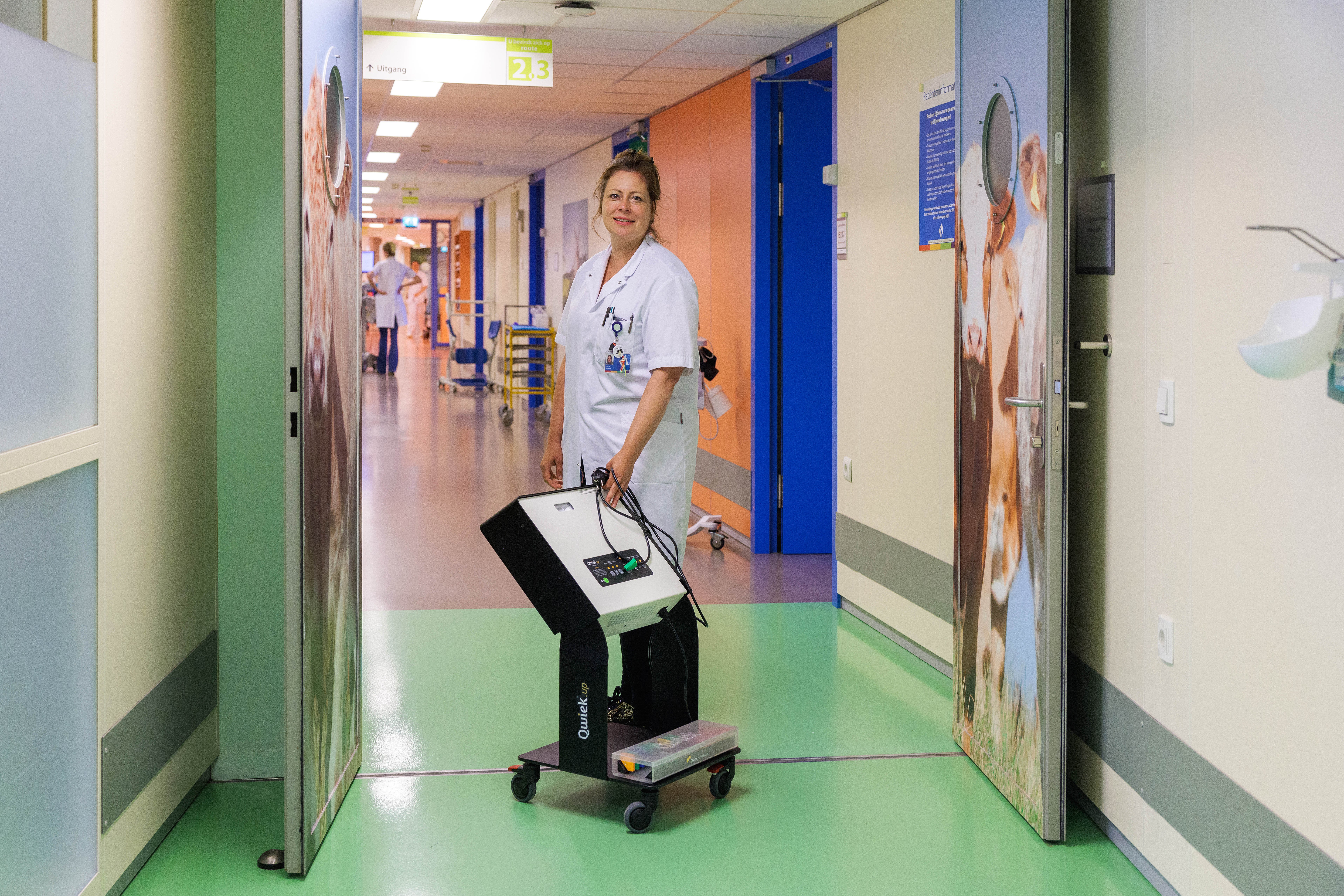
To promote patients' mental calm and wellbeing, Martini Hospital made the Qwiek.up a permanent part of its therapeutic toolbox. Because the system is mobile, Mariël takes it throughout the hospital. She uses it in the ICU, Paediatrics, the Burns Centre and Geriatrics. With large audiovisual projections on the wall or ceiling, the Qwiek.up instantly changes the atmosphere in a hospital room. Mariël uses projections such as the Starry Sky module in two ways. For bedridden patients, she uses them for targeted relaxation exercises. In the shared living rooms, they support activities led by trained volunteers.
The results
The usage figures also show that the Qwiek.up has become a permanent part of care. In Paediatrics alone, the device has run some 240 hours with eleven different Qwiek experience modules since 2022. Underwater World, Look & Find Summer and Aquarium were chosen most often there. In 2026, the hospital expanded with two additional Qwiek.ups.
In the ICU, the large video projection combined with music helps drown out the hectic environment of the ward. It creates a safe bubble in which patients can relax and call up positive, empowering images. According to Mariël, this has a very healing effect.
In the geriatric wards, the Qwiek.up works as an accessible tool for activation. The projections bring older patients into a certain flow, making it easier for them to take action almost automatically. During a craft activity with the Starry Sky projection, for example, patients immediately started making personal wishing stars. This experience-based approach stimulates social contact and independence. Mariël also sees it contributing to a smoother transition to geriatric rehabilitation care. Or, as she puts it herself: the Qwiek.up helps to offer patients "points of light on the horizon" again.